
Skip to content

Programme

Conservatory Preparation Studio

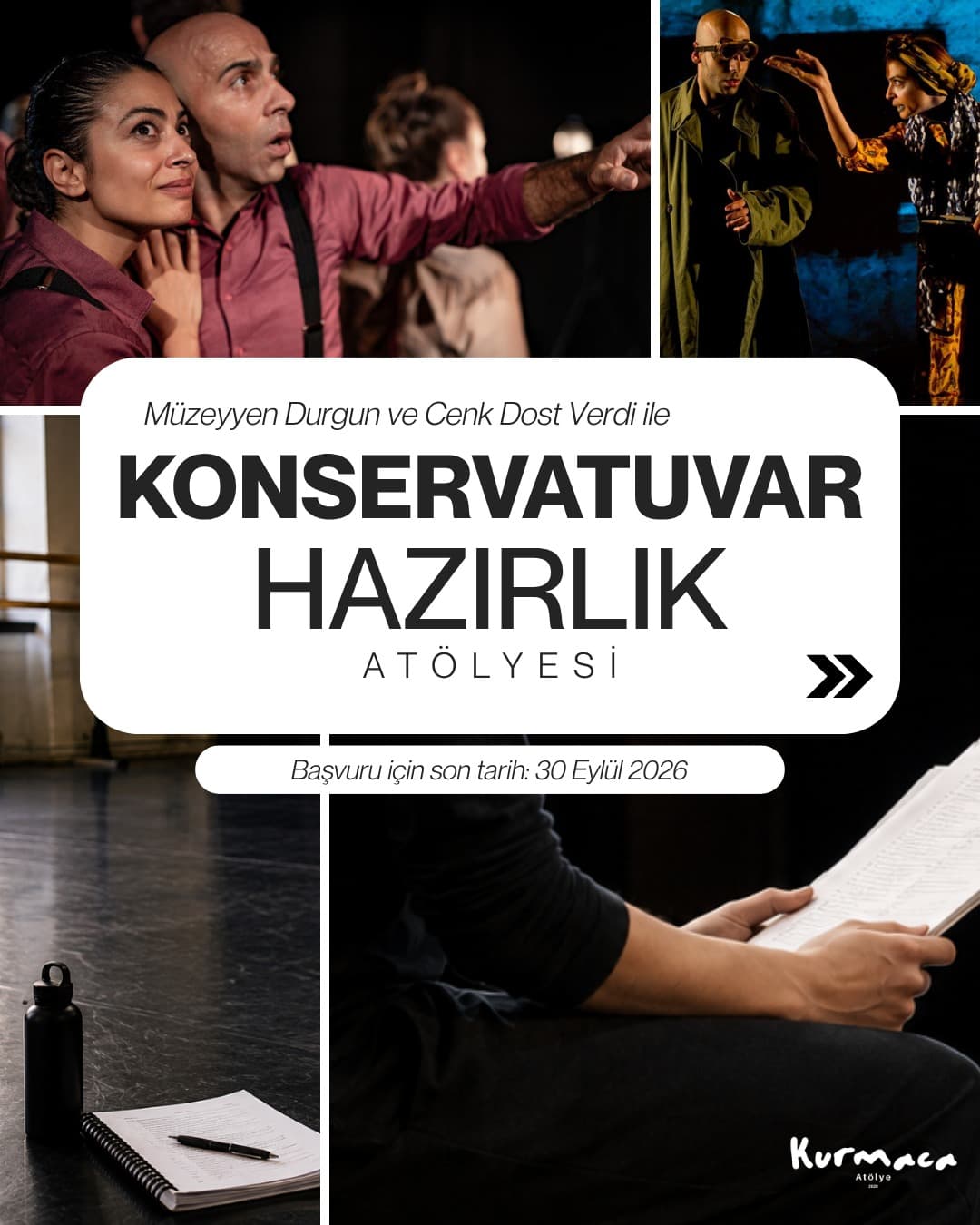
With Müzeyyen Durgun and Cenk Dost Verdi — an eight-month season of work, October to May, for candidates preparing for the acting auditions of conservatories and fine-arts faculties.

Go to the application form
Season
October – May
Length
8 months
Schedule
2 days a week · 6 hours in total
Applications close
30 September 2026
Poster for the Conservatory Preparation Studio: a collage of rehearsal and stage photographs

Approach

How the programme works

The programme is not built around assembling an audition repertoire. It is built around meeting the fundamental concepts of acting through practice, observation, research and theory.

Participants learn the concept behind each technique they use, become fluent in the basic vocabulary of theatre and acting, and grow familiar with the academic language they will meet at a conservatory or a fine-arts faculty.

The work moves through three stages: foundation training, audition-focused work, and the audition laboratory.

Instructors

Who runs the programme

Portrait not added yet

Müzeyyen Durgun

Programme lead

A graduate of the Acting programme at Çanakkale Onsekiz Mart University's Faculty of Fine Arts, Department of Performing and Visual Arts. She works across theatre, physical theatre, dance, musicals, screen acting and voice.

She has performed in productions at İstanbul Devlet Tiyatrosu, Yolcu Tiyatro, Ekip Kafile, Dof Tiyatro, Zorlu Çocuk Tiyatrosu and Tiyatro Tiyatral — among them Coriolanus, The Chronicles of Narnia, The Man Outside and Dans Eden Ev, directed by Yasin Yürekli. She appeared in the dance piece Dislokasyon at Akbank Sanat, and has worked in television, short film, advertising and voice-over.

Her practice deepened in physical theatre and movement-based acting: alongside the School of Physical Theatre and Comedy, grounded in Jacques Lecoq's pedagogy, she has trained in clown, physical comedy and storytelling. With teaching experience in drama and diction, she brings acting, body, movement, play and stage practice together in the studio.
Portrait not added yet

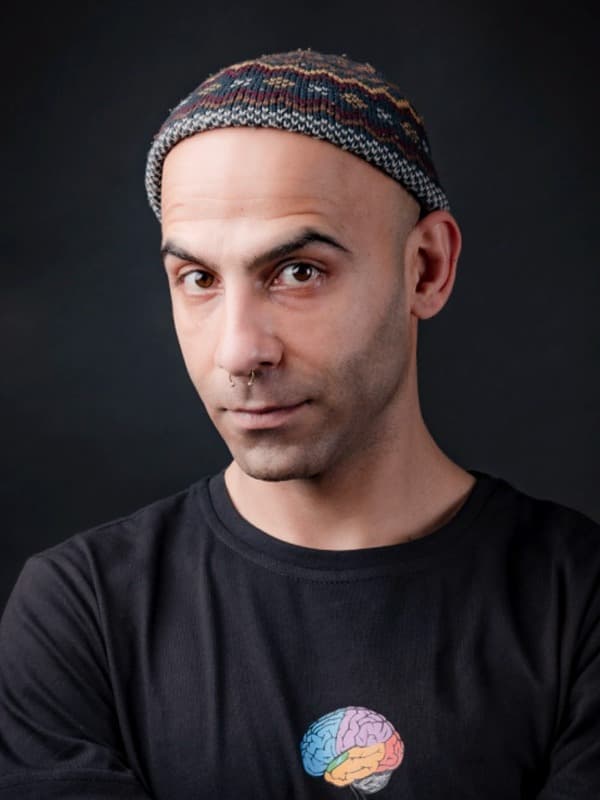
Cenk Dost Verdi

Programme lead

A short biography is on its way.

Term I October – January

Foundation Training

Open a module to read what it covers

Improvisation and Creative Drama

Play and improvisation build spontaneity, attention, concentration, imagination, observation and contact with a partner. Inside a fictional situation, the participant discovers given circumstances, objective, action, obstacle, conflict, status, space and time through practice. The aim is not only to complete the exercise but to recognise the term that names what was done.

Key concepts Play · Fiction · Improvisation · Spontaneity · Given circumstances · Objective · Action · Obstacle · Conflict · Partner · Status · Attention · Concentration · Imagination · Space · Time

Diction, Voice and Speech

The voice is met as one of the actor's instruments: breathing, phonation, resonance and articulation are studied at a working level. Breath and body coordination are developed, the speech organs are understood, and habits are built for a healthy, intelligible voice that carries on stage. Stress, intonation, pause, tempo and rhythm are treated as carriers of thought and action rather than decoration.

Key concepts Breathing · Diaphragm · Phonation · Resonance · Articulation · Diction · Intonation · Stress · Pitch · Pause · Tempo · Rhythm · Prosody

Movement and Physical Preparation

The body is met as one of the actor's instruments, and the participant develops an awareness of their own physical range and limits. Alongside strength, stamina, flexibility, balance, coordination and range of motion, the work asks how centre of gravity, weight transfer, direction, space, tempo and rhythm relate to acting. The aim is a regular, safe physical practice that continues outside the studio.

Key concepts Body awareness · Conditioning · Stamina · Flexibility · Mobility · Coordination · Balance · Centre of gravity · Weight transfer · Body centre · Tempo · Rhythm · Spatial awareness

Voice I and Aural Training

The participant gets to know their own voice while building basic aural skills, a sense of rhythm and reliable tone production. Listening and repetition exercises on one, two and three notes train the ear to hear differences in pitch and to repeat simple melodic and rhythmic figures. Linking voice work to acting reduces the hesitation many candidates feel around music and prepares the song work that follows.

Key concepts Aural training · Pitch · Intonation · Melody · Rhythm · Tempo · Vocal range · Repetition · Ear training

Reading Plays and Dramaturgy

A dramatic text is treated as a historical, social, aesthetic and dramaturgical whole rather than a supply of lines to memorise. Structure, plot, theme, conflict, character, situation, time, place and given circumstances are examined to build a working method of textual analysis. A monologue is never taken apart from the play it belongs to: what the character does and says is read from its context in the whole.

Key concepts Dramaturgy · Dramatic structure · Plot · Theme · Motif · Conflict · Character · Situation · Given circumstances · Subtext · Context · Textual analysis

Watching and Criticising Theatre

Watching theatre stops being a verdict of personal taste and becomes a practice of observing, analysing, interpreting and justifying. Productions are discussed in terms of acting, direction, dramaturgy, set, light, costume, music, sound, rhythm and the relationship built with the audience — which is also how the basic vocabulary of staging is learned.

Key concepts Staging · Direction · Acting style · Dramaturgy · Set design · Scenery · Costume · Lighting design · Sound design · Blocking · Tempo-rhythm · Actor–audience relationship · Criticism

Literature and Reading

The aim is a regular reading habit that reaches well beyond plays, across genres and periods. Novels, short stories, poetry, essays and drama widen the candidate's ear for language, vocabulary, cultural reference and imagination. Meeting a range of Turkish and international writers, the participant learns to think about what they have read, to ask questions of it, and to state a view in speech and in writing.

Key concepts Literature · Genre · Narrative · Poetry · Short story · Novel · Essay · Imagination · Sensitivity to language · Interpretation

Term II February – April

Audition-Focused Work

Monologue and Scene Work

What was learned in the first term is now applied to text, and each participant develops an audition repertoire suited to them. Working from the dramaturgical context, monologues are explored through given circumstances, super-objective, scene objective, action, obstacle, conflict, subtext, turning points and tempo-rhythm. The goal is acting built on action — able to change, and alive to a partner — rather than a fixed reading or a rehearsed emotion.

Key concepts Monologue · Scene · Given circumstances · Super-objective · Scene objective · Action · Obstacle · Tactic · Subtext · Turning point · Tempo-rhythm · Partner · Direction

Dance, Movement and Rhythm

The relationship between movement and music is worked through: rhythm, tempo, coordination, direction, space, weight transfer and movement sequence. The aim is not mastery of one dance discipline but the ability to watch a given sequence, learn it, repeat it in the body, and sustain it inside the music — which is what an audition actually asks for.

Key concepts Rhythm · Tempo · Coordination · Direction · Space · Weight transfer · Movement sequence · Musicality

Movement II: Yoga, Stretching and Acrobatic Preparation

The body awareness built in the first term is extended into flexibility, mobility, balance, core strength and coordination. Yoga and stretching widen the body's range safely, and basic acrobatic preparation is done under proper supervision. The point is to treat the body as a stage instrument that can be trained and changed, not as a fixed given.

Key concepts Flexibility · Mobility · Balance · Core strength · Coordination · Stretching · Body control · Acrobatic preparation

Theatre History, Theory and Approaches to Acting

The history of theatre is followed through its periods, forms, artists and shifts in thinking. From ancient Greece to the contemporary stage, the course looks at how dramatic form, staging, the actor–audience relationship and ideas about acting have changed. Meeting several approaches side by side gives the candidate a historical and theoretical perspective — and the understanding that there is no single correct way to act.

Key concepts Mimesis · Catharsis · Dramatic theatre · Realism · Naturalism · Epic theatre · Alienation · Physical theatre · Actor training · Performance · Representation · Form · Style

Voice II: Music, Melody and Rhythm

Aural skills are developed further, alongside melody, rhythm, tempo, metre, pitch and the rudiments of notation — all in practice rather than on paper. The candidate learns to repeat what they hear, to know their own range, and to sing alone under the conditions an audition creates.

Key concepts Melody · Rhythm · Tempo · Metre · Pitch · Notation · Aural training · Vocal range · Intonation

Term III Late April – late May

Audition Laboratory and Simulations

Audition Laboratory

Everything built over the season — acting, body, voice, speech, music, movement, textual analysis — is now used together, under the shifting conditions of a real audition. The candidate does more than present a prepared repertoire: they take a new direction from the panel, adapt quickly, improvise, repeat rhythm and movement sequences, and hold their concentration when something unexpected happens. The simulations make performance anxiety, time pressure and uncertainty familiar in a place where it is safe to meet them.

Key concepts Audition repertoire · Performance · Adaptation · Taking direction · Improvisation · Concentration · Performance anxiety · Self-regulation · Stage discipline · Talking to the panel

Contact

Anything you want to ask?

For anything about the programme, the schedule or the fees, write to us directly or reach us on WhatsApp.

Apply

Apply to the programme

Leave your details and we will call you. Applying is not enrolment: we meet first, and decide together whether the programme is right for you.

Places are limited and applications are reviewed in the order they arrive.

We will call this number to arrange an introductory meeting.

Security check

Loading the check…